Scandinavian Solid Wood Platform Bed with Tall Headboard

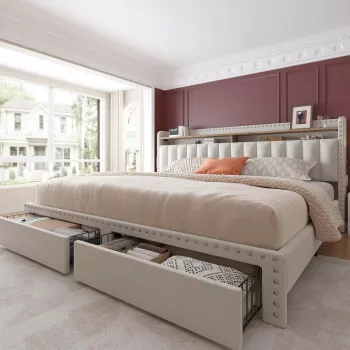
Solid Wood Platform Bed Frame with High Headboard – Scandinavian Style
A solid wood platform bed with a tall headboard brings the quiet warmth of Scandinavian interiors into the bedroom while keeping the setup practical: supportive slats, clean lines, and a grounded, low-fuss footprint. The result is a bed that feels visually calm yet substantial—designed to anchor the room without overwhelming it. Below is what to expect from this style of frame, how it behaves in everyday use, and how to keep it looking and feeling steady for years.
Why this bed frame suits Scandinavian-inspired bedrooms
Scandinavian rooms tend to rely on a few strong elements—honest materials, breathable spacing, and purposeful silhouettes. A solid wood platform bed with a high headboard fits naturally into that formula.
- Solid wood presence: Natural grain and warm tone create a calmer focal point than glossy or highly ornate frames. Because each board varies, the bed reads as organic rather than mass-produced.
- High headboard impact: A taller headboard adds definition and visual height, so the bed looks intentional even with minimal décor.
- Platform profile: The streamlined silhouette pairs easily with light bedding, neutral palettes, and simple nightstands—no extra layers required.
- Works across looks: With the right textiles, this style blends smoothly with Japandi, mid-century-leaning minimalism, and modern rustic interiors.
If you’re shopping for a centerpiece that keeps the room feeling airy while still looking “finished,” consider the Solid Wood Platform Bed Frame with High Headboard – Scandinavian Style.
Comfort and daily use: headboard, support, and stability
Beyond aesthetics, a bed frame has to perform every day—supporting your mattress, staying quiet, and feeling secure when you sit, shift, or climb in and out.
Headboard comfort
A tall headboard can feel more supportive for reading or scrolling in bed, especially when paired with a couple of firmer pillows. It also keeps pillows from slipping into the gap behind the mattress, which helps the bed stay neat with less fuss.
Mattress support and airflow
Platform frames typically rely on a slat system to distribute weight. Slat spacing and rigidity affect both comfort and longevity—tighter, even spacing tends to support more mattress types reliably. Slats also allow airflow beneath the mattress, which can help manage moisture compared with solid decking. For a broad overview of platform bed benefits and considerations, the Sleep Foundation is a helpful reference.
Noise control basics
Wood frames can loosen slightly over time as they settle and respond to seasonal humidity changes. Even, secure joinery plus evenly tightened hardware reduces squeaks; periodic re-tightening is normal maintenance, not a flaw.
Quick checklist before ordering
| Detail to confirm | Why it matters | What to look for |
|---|---|---|
| Overall size (Twin/Full/Queen/King) | Ensures a proper fit in the room and with existing mattress | Match mattress size; measure bedroom clearances around the bed |
| Headboard height | Affects visual balance and back support when sitting up | Enough height above mattress for pillows; aligns with wall art placement |
| Slat spacing and center support | Influences mattress performance and long-term sag prevention | Even spacing; center beam/support legs for larger sizes |
| Under-bed clearance | Determines storage options and ease of cleaning | Fits bins/robot vacuum if desired |
| Finish and care requirements | Impacts maintenance and resistance to scuffs | Sealed wood finish; simple wipe-down upkeep |
Materials and craftsmanship: what “solid wood” changes
“Solid wood” isn’t just a marketing phrase—it changes how a bed ages, how it feels, and how it can be maintained over time.
- Durability and repairability: Solid wood frames can better tolerate years of tightening/loosening and are generally easier to touch up than laminates if you ever get a scratch.
- Natural variation: Grain patterns and color shifts are normal; two pieces rarely look identical. This variation is a feature in Scandinavian spaces, where subtle imperfection adds warmth.
- Joinery matters: Strong corner connections and center reinforcement are key indicators of long-term stability, especially as the bed experiences movement night after night.
- Finish quality: A well-applied protective finish helps reduce staining and makes routine cleaning simpler.
When comparing wood types, grading, and general hardwood characteristics, the National Hardwood Lumber Association (NHLA) offers useful background. If responsible sourcing is important, look for certification details such as Forest Stewardship Council (FSC) standards from brands that provide them.
Styling ideas that keep the look calm (not cold)
Assembly, placement, and long-term care
Coordinating pieces for a cohesive bedroom
- Storage pairing: A clean-lined wardrobe complements a minimal bed profile and reduces clutter. The Modern Glass Door Wardrobe Armoire with LED Lights, 59.1″ Wide Closet Organizer adds closed storage with a modern finish that still reads light.
- Work corner option: If your bedroom doubles as a workspace, choose a simple desk with understated contrast—wood plus dark metal is a classic pairing. The 55 Inch Heavy Duty Writing Computer Desk with Z-Shaped Metal Legs fits that functional, streamlined approach.
- Keep the palette restrained: Repeating two to three core materials (wood, soft textile, matte metal) makes the room feel cohesive without trying too hard.
FAQ
Does a platform bed frame need a box spring?
Most platform bed frames are designed to support a mattress directly on slats or a platform surface, so a box spring is usually not needed. Always confirm your mattress warranty requirements and check that slat spacing and center support meet the mattress maker’s guidelines.
Will a high headboard work in a small bedroom?
Yes—high headboards can actually make a small room feel more structured if you keep the rest of the styling light. Use slim nightstands, minimal wall décor, and warm, space-saving lighting so the headboard doesn’t feel crowded.
How can wood bed frames be kept from squeaking?
Re-tighten hardware after the first couple of weeks, then periodically as the wood settles. Make sure slats are seated evenly, add felt pads under legs, and confirm the bed sits level so no corner is bearing extra pressure.










Leave a comment